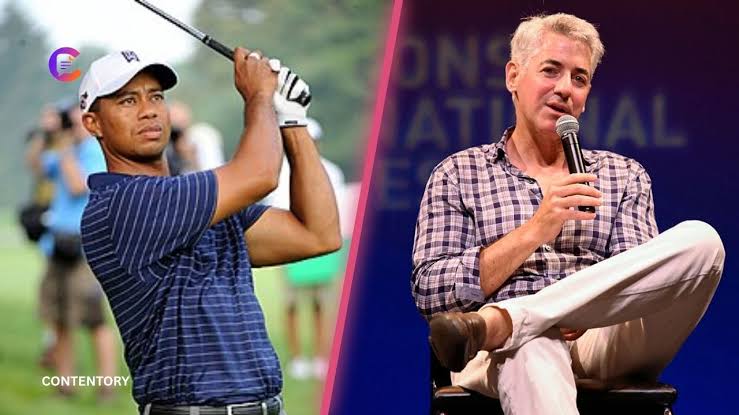
Bill Ackman and Tiger Woods may seem like an unlikely pair at first glance. One has built a reputation as a powerful hedge fund manager who challenges major corporations, while the other has transformed professional golf through extraordinary talent, commercial success, and unforgettable performances. Yet their stories share several interesting themes, including enormous wealth, public pressure, personal resilience, and the ability to rebuild a reputation after difficult periods.
The connection between these two American public figures becomes particularly interesting when business and sports overlap. Their names entered the same broader conversation through Nike, a global sportswear company that maintained a historic partnership with Woods before attracting a major investment from Ackman’s Pershing Square Capital Management. Although they have different careers and professional priorities, their experiences offer valuable insights into leadership, branding, financial risk, and long-term success.
Understanding Bill Ackman and Tiger Woods requires looking beyond their fortunes or celebrity status. Their careers reveal how public perception can change, how influential individuals respond to setbacks, and why strong personal brands can remain valuable even when circumstances shift. While their paths are not identical, examining their similarities and differences provides a fascinating look at two very different forms of modern success.
Personal Information About Bill Ackman and Tiger Woods
The following table summarizes some basic information about both personalities and highlights the professional differences that make their stories interesting.
| Personal Information | Bill Ackman | Tiger Woods |
|---|---|---|
| Full name | William Albert Ackman | Eldrick Tont Woods |
| Known as | Bill Ackman | Tiger Woods |
| Birth date | May 11, 1966 | December 30, 1975 |
| Birthplace | Chappaqua, New York, United States | Cypress, California, United States |
| Nationality | American | American |
| Primary profession | Investor and hedge fund manager | Professional golfer |
| Main organization | Pershing Square Capital Management | Professional golf and related business ventures |
| Main area of expertise | Activist investing and corporate strategy | Competitive golf and sports entrepreneurship |
| Notable association | Nike investment | Long-term Nike partnership |
| Main source of wealth | Investment management and investments | Golf earnings, endorsements, and business ventures |
| Public reputation | High-profile activist investor | One of golf’s most influential champions |
Both men are prominent American figures, but their achievements come from different professional environments. Ackman’s career revolves around financial markets, corporate valuations, and decisions about where capital should be invested. Woods built his reputation through athletic performance, discipline, and an ability to attract audiences around the world. Their shared association with Nike provides a useful starting point for understanding how finance and sports can intersect.
How Bill Ackman and Tiger Woods Became Connected Through Nike
Nike provides the clearest business connection between these otherwise unrelated personalities. For decades, Tiger Woods was one of the company’s most recognizable sponsored athletes. His relationship with the sportswear giant began in 1996, when he turned professional, and became one of the most famous endorsement partnerships in sports history. Woods helped Nike strengthen its position in golf apparel and connect its products with excellence, ambition, and championship performance. The partnership continued for approximately 27 years before ending in January 2024, marking the conclusion of an important chapter in the company’s relationship with professional golf.
Bill Ackman entered the Nike conversation from a completely different direction. In 2024, his investment firm, Pershing Square Capital Management, disclosed a substantial position in Nike shares. Rather than representing a personal endorsement relationship, Ackman’s involvement reflected an investor’s assessment of the company’s future prospects. His investment attracted attention because Nike was navigating business challenges involving product strategy, competition, and its relationships with consumers. The timing encouraged observers to compare the end of Woods’s long association with Nike and Ackman’s financial interest in the company, although the two events were separate developments rather than evidence of a direct relationship between the men.
Bill Ackman’s Investing Career and Business Philosophy
Bill Ackman established himself as one of the most recognizable activist investors in the United States. Through Pershing Square Capital Management, he has pursued investments in publicly traded companies while sometimes pushing management teams to reconsider their strategies, improve operations, or make significant corporate changes. Activist investing differs from simply purchasing shares and waiting for their value to increase. It can involve extensive research, public presentations, negotiations with executives, and campaigns intended to influence business decisions. Ackman’s approach has attracted considerable attention because his investments can place him at the center of debates about corporate leadership, shareholder value, and the responsibilities of major companies.
His investing philosophy has also evolved through experience. Ackman has experienced periods when prominent investment positions produced substantial losses, including his controversial short position against Herbalife and his investment in Valeant Pharmaceuticals. These episodes attracted criticism and demonstrated the risks involved in making concentrated financial bets. Rather than defining his entire career, however, the setbacks became part of a larger story about adapting an investment strategy. By 2019, Pershing Square had delivered a strong recovery, reinforcing Ackman’s reputation as an investor capable of learning from mistakes and rebuilding confidence in his approach. His career illustrates that financial success depends not only on identifying opportunities but also on managing uncertainty and recognizing when a strategy needs to change.
Tiger Woods and His Extraordinary Rise in Professional Golf
Tiger Woods became a global sporting phenomenon because of his unusual combination of technical skill, competitive intensity, and consistent performance under pressure. After turning professional in 1996, he quickly rose through the golf rankings and became one of the sport’s biggest attractions. His achievements included 15 major championship victories and 82 PGA Tour wins, tying the all-time record for official PGA Tour victories. His 1997 Masters victory, in particular, announced the arrival of a remarkable talent and helped introduce golf to wider audiences. Woods’s success changed expectations about what a dominant modern golfer could accomplish and established him as one of the most influential athletes of his generation.
His influence extended beyond tournament results. Television audiences, sponsorship opportunities, golf equipment sales, and public interest in professional tournaments all benefited from his popularity. Woods brought a new level of attention to the sport, attracting people who might not previously have followed golf closely. His powerful public image also helped create commercial opportunities that continued well beyond individual victories. Although his competitive career has included significant interruptions, his accomplishments remain central to golf’s modern history. His story demonstrates how exceptional performance can transform an athlete into a cultural figure whose influence reaches far beyond the playing field.
Comparing Their Comeback Stories
One reason people discuss Bill Ackman and Tiger Woods together is that both have experienced highly publicized periods of difficulty followed by renewed attention to their achievements. Ackman’s financial setbacks challenged confidence in his investment judgment, especially when major positions produced losses and critics questioned his approach. His subsequent recovery showed the importance of reviewing assumptions, refining investment decisions, and rebuilding a business around a clearer strategy. The strong performance of Pershing Square in 2019 helped change the conversation about his career. However, his recovery should not be interpreted as proof that every later investment will succeed. Financial markets remain unpredictable, and even experienced investors can make costly mistakes.
Woods’s comeback story unfolded under very different circumstances. Injuries and personal difficulties disrupted his career, creating uncertainty about whether he could compete at the highest level again. His 2019 Masters victory became one of the most celebrated sporting comebacks of the modern era. After years of physical challenges, Woods returned to the top of the game and won one of golf’s most prestigious tournaments. The achievement demonstrated remarkable competitive determination, although it did not mean that his health challenges had disappeared. Comparing the two men highlights a shared theme: setbacks can change a person’s professional direction, but a comeback usually requires patience, adaptation, and sustained effort rather than a single dramatic moment.
Wealth and the Different Sources of Their Fortunes
Bill Ackman and Tiger Woods are both associated with billionaire-level wealth, but the ways they built their fortunes differ substantially. Ackman’s wealth is closely tied to his ownership interests, investment performance, and business activities through Pershing Square. His financial position can be influenced by stock prices, fund performance, market conditions, and the valuation of his investments. Because these factors change, any estimate of his net worth represents a snapshot rather than a guaranteed or permanently fixed amount. His public profile also reflects the broader economics of investment management, where financial judgment and access to capital can create substantial rewards but involve considerable risk.
Woods’s wealth developed through a combination of professional golf earnings, endorsement agreements, licensing, and business ventures. Although tournament winnings contributed significantly to his success, commercial partnerships have played an especially important role in his financial story. His long relationship with Nike helped make him one of the most commercially successful athletes in history. Other sponsorships and golf-related ventures have also contributed to his earning power. The distinction is important: Ackman’s wealth is primarily associated with investing and financial ownership, while Woods built his fortune through athletic achievement and the commercial opportunities that followed. Both demonstrate how specialized expertise can become financially valuable when combined with a strong reputation and access to large markets.
Nike’s Brand Strategy and the End of a Historic Partnership
The conclusion of Tiger Woods’s Nike partnership in January 2024 marked a major change in sports marketing. Woods had represented the company for nearly three decades, helping Nike establish a recognizable presence in golf apparel. His association with the brand connected products with winning, confidence, and the pursuit of excellence. For Nike, such partnerships offered more than advertising exposure. A superstar athlete could influence consumer preferences, increase the visibility of product launches, and strengthen emotional connections between customers and a company. Ending a relationship of that duration therefore represented a significant transition, even though Nike’s overall business continued to depend on a much broader collection of products, athletes, and markets.
Nike’s business challenges also became relevant when Ackman’s investment attracted attention. Investors were assessing the company’s ability to maintain growth, compete with established rivals and emerging brands, and strengthen its product pipeline. Ackman’s interest suggested that he saw potential value in the business despite the difficulties it faced. Nevertheless, the end of Woods’s endorsement agreement should not be treated as the direct cause of Nike’s investment appeal or as proof that the company had entered a post-superstar crisis. Nike’s financial performance depends on numerous factors, including consumer demand, inventory management, innovation, pricing, and global economic conditions. The connection between these events is primarily thematic: one concerns the evolution of a sports brand, while the other concerns an investor’s assessment of its future.
Public Image, Media Attention, and Personal Branding
Both personalities demonstrate the extraordinary power of public image, although their reputations are built on different foundations. Ackman’s public identity is connected to his willingness to challenge corporate management, communicate investment ideas, and take positions that attract strong reactions. Supporters may view his approach as a way to hold companies accountable, while critics may question the effects of activist campaigns or the risks of concentrated investing. Because his business decisions can affect companies, employees, shareholders, and public markets, his statements frequently receive attention beyond the investment community. His reputation is therefore shaped by financial results as well as by how effectively he explains his decisions and responds to criticism.
Woods’s public image has been shaped by championship performances, commercial partnerships, and the intense scrutiny that accompanies international sporting fame. His success helped build an identity associated with determination and competitive excellence, but public discussion has also included personal controversies and periods of physical recovery. Such attention illustrates the challenges faced by athletes whose private difficulties can become major news stories. In both cases, public perception can influence professional opportunities, but neither man is defined entirely by media coverage. Ackman’s long-term credibility depends substantially on investment judgment, while Woods’s sporting legacy rests on achievements that remain significant regardless of changing headlines. Their experiences show that a public brand can be influential while still being vulnerable to changing circumstances.
Tennis, Golf, and Their Different Approaches to Competition
Tiger Woods and Bill Ackman also attract interest because of their involvement in sports, although their levels of professional achievement are entirely different. Woods is an elite golfer whose competitive record places him among the greatest athletes in the sport. Golf has been his primary profession for decades, requiring technical precision, physical conditioning, course management, and the ability to perform under intense pressure. His experience shows how sustained excellence can develop through repetition and preparation over many years. Even when injuries limited his ability to compete, his connection to golf remained central to his identity and his business activities.
Ackman, by contrast, is known primarily for finance but has pursued tennis with considerable enthusiasm. His interest has drawn attention because he has participated in competitive tennis events despite being widely recognized as a billionaire investor rather than a professional athlete. His reported appearance alongside former professional player Jack Sock at the 2025 Hall of Fame Open generated discussion about access, competition, and the relationship between wealth and sporting opportunity. The comparison requires perspective: playing competitive tennis can be a meaningful personal pursuit without making someone equivalent to an elite professional athlete. Woods built his career through decades of world-class golf, whereas Ackman’s sporting interests represent a different dimension of his life beyond financial markets.
Lessons About Leadership, Risk, and Resilience
The careers of these two men offer several useful lessons about dealing with uncertainty. Ackman’s experience illustrates that strong convictions can create substantial opportunities, but they can also expose investors to serious losses. Successful investing requires research, the willingness to question assumptions, and an understanding that even well-developed arguments can be wrong. His professional recovery also shows why evaluating a career over time can be more informative than focusing on one unsuccessful position. Investors can learn from both his achievements and his setbacks without assuming that his decisions should be copied automatically. Individual financial circumstances, risk tolerance, and investment goals differ, so a famous investor’s strategy is not necessarily appropriate for everyone.
Woods’s career highlights the importance of preparation, adaptability, and perseverance in a highly demanding profession. His return to major championship success in 2019 demonstrated that an athlete can remain competitive after a long period of difficulty. At the same time, his experiences show that determination does not eliminate physical limitations or guarantee future victories. Recovery often requires realistic expectations and adjustments to changing circumstances. Together, these stories suggest that resilience is not simply about returning to a previous position. It can also mean developing a different strategy, accepting limitations, and finding ways to remain effective as conditions evolve. Whether in investing or sports, long-term success depends on learning from experience rather than expecting uninterrupted progress.
Why Bill Ackman and Tiger Woods Continue to Attract Attention
The ongoing interest in Bill Ackman and Tiger Woods reflects more than their wealth. Both have spent decades in highly visible professions where individual decisions and performances can attract worldwide attention. Ackman represents the influence of modern finance, where investors can shape discussions about corporate direction and shareholder value. Woods represents the power of sport to produce global icons whose achievements influence business, entertainment, and popular culture. Their different career paths make them useful examples of how people can build public influence through specialized skills, consistent performance, and opportunities that extend beyond their original professions.
Their stories also remain relevant because neither career can be understood through a single achievement or setback. Ackman’s investment record includes both substantial disappointments and periods of strong returns, while Woods’s golfing legacy includes historic victories alongside years interrupted by injury. The Nike connection gives their stories a practical business link, but it does not establish a direct personal relationship between them. Instead, it illustrates how athletes, corporations, and investors can become part of the same commercial conversation. Their continued public relevance comes from the combination of professional accomplishments, financial significance, and the broader questions their careers raise about risk, reputation, and the ability to adapt.
Conclusion
Bill Ackman and Tiger Woods have built remarkable careers in two very different worlds. Ackman became a prominent figure in activist investing through his work at Pershing Square Capital Management, while Woods established himself as one of golf’s greatest champions and most successful commercial athletes. Their shared connection through Nike highlights the intersection of corporate strategy, sports marketing, and investment decisions.
Their experiences also reveal important differences between financial and athletic success. Ackman’s career depends on investment judgment, corporate analysis, and the management of financial risk. Woods’s legacy rests on competitive achievements, endurance, and the commercial influence created by his sporting excellence. Both have experienced difficult periods that became part of their public narratives, but their stories should not be reduced to simple comeback formulas.
Ultimately, the connection between Bill Ackman and Tiger Woods is less about a direct partnership and more about the ways influence, reputation, and resilience operate across industries. Their careers show that lasting success requires more than wealth or recognition. It also requires expertise, the ability to respond to changing circumstances, and a willingness to learn from both achievements and setbacks.
Frequently Asked Questions
1. Are Bill Ackman and Tiger Woods friends?
There is no widely established public evidence that they have a close personal friendship. Their names are connected mainly through broader business discussions involving Nike, wealth, and public influence.
2. What connects Bill Ackman and Tiger Woods?
Nike is the clearest connection. Woods maintained a long-term endorsement partnership with Nike, while Ackman’s investment firm acquired a substantial position in the company’s shares in 2024.
3. Is Bill Ackman richer than Tiger Woods?
Their estimated fortunes fluctuate with investment valuations and business performance. Both are associated with billionaire-level wealth, but a precise comparison requires current, consistently dated estimates.
4. Why did Tiger Woods and Nike end their partnership?
Their approximately 27-year partnership concluded in January 2024. The announcement marked the end of a historic endorsement relationship, but the specific reasons should not be reduced to speculation about Nike’s business performance.
5. What is Bill Ackman famous for?
Ackman is best known as an activist investor and the founder and chief executive of Pershing Square Capital Management. He is recognized for taking significant positions in publicly traded companies and advocating corporate changes.
6. What is Tiger Woods most famous for?
Woods is famous for his exceptional golf career, including 15 major championship victories, 82 PGA Tour wins, and his memorable 2019 Masters victory.
7. Did Bill Ackman make a career comeback?
Ackman experienced significant investment setbacks before Pershing Square delivered strong results in 2019. That performance was widely viewed as a recovery, although investment outcomes remain uncertain.
8. What can business leaders learn from their stories?
Their careers highlight the importance of preparation, informed decision-making, adaptability, and resilience. They also demonstrate that success in competitive environments involves managing risk, learning from setbacks, and maintaining realistic expectations.